The unitree g1 university buy or rent question is one our team hears constantly in 2026. Labs with active grants, rotating student cohorts, and tight overhead budgets rarely have the same needs two semesters in a row. Whether purchase or rental fits depends on timeline, maintenance appetite, and how your department handles capital equipment.
Table of Contents
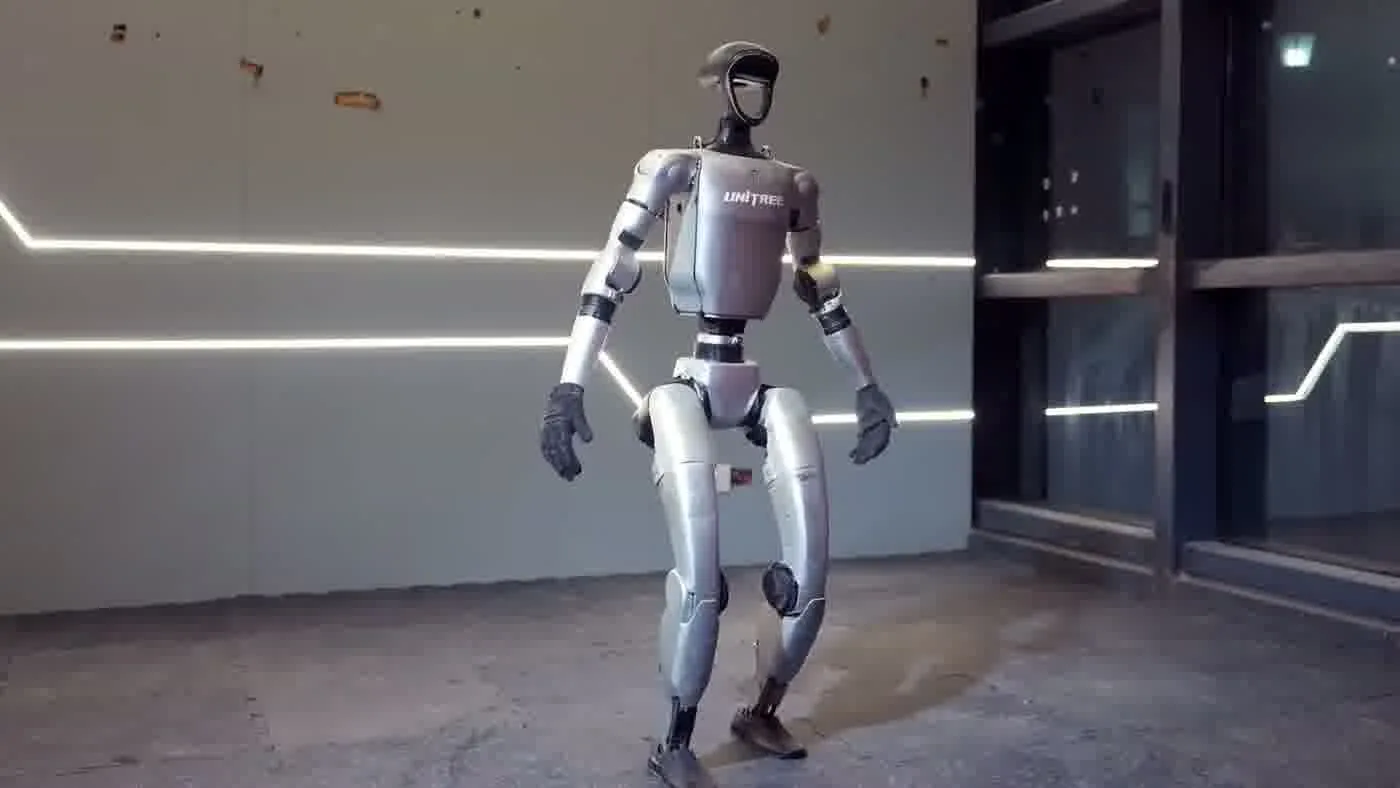
Office Hallway Walk Demo
Unitree G1 — At a Glance
- 127 cm tall | 35 kg
- 41 degrees of freedom
- Five-finger dexterous hands
- 2-hour operational battery
- Onboard NVIDIA Jetson Orin
- Available to rent from $299/day
What You Should Know
Before committing to either path, these are the numbers and operational facts that drive the decision:
- The Unitree G1 enterprise configuration costs $70,000; the base model starts at $13,500 with significantly limited research capability.
- At a rental rate starting from $299/day (3-day minimum), a lab would need 234 rental-equivalent days of use before purchase price becomes cost-neutral — not counting maintenance.
- Annual maintenance on capital robotics equipment runs roughly 10-15% of purchase price per year — a real carrying cost that ownership math must include.
- The G1 runs on a 9000mAh battery with a 2-hour runtime and 45-minute charge time — a factor in scheduling around lab sessions and experiments.
- At 35kg and 127cm tall with 41 degrees of freedom, the G1 requires dedicated floor space, charging infrastructure, and trained handlers.
- Research labs in NSF, NIH, and DARPA grant cycles often cannot capitalize equipment purchases mid-grant — rental can come from operational rather than capital budgets.
- Depreciation schedules for robotics hardware are aggressive; a purchased G1 may carry diminished book value within 18-24 months as successor models ship.
The Real Cost of Buying for a Lab
A $70,000 purchase price is the starting point, not the finish line. University procurement offices know this — capital equipment acquisitions trigger a cascade of administrative overhead that individual PIs often underestimate when they first price the G1.
On most campuses, equipment above $5,000 must be capitalized, tagged, and depreciated on a fixed schedule. The physical asset then belongs to the university, not the lab — which matters when a grant ends and the equipment must be either transferred, surplused, or written down. If your department overhead recovery rate runs at 50-60% of direct costs, the administrative drag on a $70,000 purchase adds real friction.
Then there is the maintenance question. Capital robotics hardware typically carries 10-15% annual maintenance costs, covering parts, firmware updates, and technician time. Unlike commercial event operators who amortize that cost across dozens of rental engagements, a single research lab absorbs the full bill. The G1’s 2-hour battery runtime and 45-minute charge cycle also mean labs running multi-hour experiments need multiple battery packs — an additional capital outlay not included in the base $70,000. MIT Technology Review’s coverage of academic robotics programs notes how maintenance budgeting is consistently underestimated in lab equipment planning.
Facilities requirements are another real cost. A 35kg, 127cm robot needs cleared floor area, a designated charging station, and physical security. Labs in older buildings often need minor retrofits. And because the G1 moves at up to 2 m/s and has 41 active joints, any space where it operates needs a safety review — which can mean IRB involvement if human subjects research is in the same vicinity.
The honest ownership picture: $70,000 purchase, annual maintenance at 10-15% of purchase price, plus facilities overhead, depreciation administration, and eventual disposal. For labs with year-round, continuous use, those numbers can pencil out. For most, they do not. How the full numbers compare is covered in our Unitree G1 total cost of ownership breakdown and the broader analysis of humanoid robot depreciation over three years.
When Rental Makes More Sense
Rental works best when your lab’s need for the G1 is bounded — a semester-long study, a specific experiment block, a demonstration for a visiting funding committee, or a conference workshop. These are real, legitimate use cases that do not require permanent ownership.
The math is simple: at the 234-day break-even point, purchase and cumulative rental costs equalize. Most research labs do not run a humanoid robot 234 days a year. A semester is roughly 16 weeks. If your lab uses the G1 two days per week during active research periods, that is 32 days per semester, or about 64 days per academic year. At that pace, you are looking at nearly four years before you hit the purchase break-even — and that calculation ignores maintenance, depreciation, and any administrative overhead.
Rental also transfers the maintenance burden entirely. When a joint actuator needs calibration or a firmware update breaks a motion routine, that is the operator’s problem, not yours. Research timelines are unforgiving; a two-week repair wait on hardware you own can kill an experiment schedule. With short-term rental, you get a known-working unit at the start of each engagement.
There is also the technology risk factor. Humanoid robotics is moving fast. The G1’s successor models will iterate on capability, sensor packages, and software interfaces. A lab that purchased in 2024 is now running hardware that is two generations behind the current research edge. Rental lets you access current-generation hardware without locking your department into a depreciation cycle on equipment that ages quickly. IEEE Spectrum’s reporting on humanoid robotics development cycles gives context for how quickly these platforms evolve.
For labs that need the robot only for demonstrations — grant reviews, department showcases, prospective student days — the case for ownership is weakest. A short-term rental for those events costs a fraction of ownership and requires no ongoing commitment. Our analysis of why renters win in 2026 goes deeper on first-time use cases.
Grant Cycles and Budget Flexibility
University research funding does not flow in a straight line. NSF and NIH grants typically run three to five years with annual budget periods. DARPA programs have phase gates. Industry-sponsored research agreements often have milestone-based disbursements. Capital equipment purchases in this environment carry risk that many PIs overlook at proposal time.
When you include a $70,000 equipment purchase in a grant budget, that number needs to survive peer review, get approved by your sponsored research office, and then survive any budget modifications during the award period. If the grant ends early, or if a no-cost extension is denied, you may own a $70,000 robot with no funding source to cover its operating costs. The equipment does not go away; the maintenance bills do not go away.
Rental sidesteps this entirely. In most university accounting systems, short-term equipment rental charges as an operating expense — supplies and services, not capital outlay. That means it can be funded from any budget period, moved between cost objects more easily, and does not require the same procurement approvals as a capital purchase. For PIs managing multiple grants or writing proposals for future awards, keeping robotics access as an operating expense maintains flexibility.
There is also the F&A (facilities and administrative) rate question. Most universities apply overhead recovery to direct costs. A $70,000 capital purchase sits in a modified total direct costs (MTDC) base calculation differently than rental does in some grant accounting frameworks — worth checking with your sponsored research office before committing either way.
For labs writing new grant proposals that include humanoid robotics access, a rental line item is often easier to justify to reviewers than a large capital purchase — especially when you can point to a specific rental vendor with defined pricing. Our humanoid robot payback period analysis gives you the numbers to back either case. TechCrunch’s coverage of robotics investment trends in 2026 also reflects how institutional buyers are approaching hardware procurement decisions.
People Also Ask
How much does it cost to buy a Unitree G1 for a university lab?
The Unitree G1 enterprise configuration — the version with full sensor suite and BrainCo Revo 2 hands needed for most research applications — is priced at $70,000. The base model starts at $13,500 but has limited capability for serious research use. Neither price includes annual maintenance, which typically runs 10-15% of purchase price per year for capital robotics equipment.
Can a university research lab rent a Unitree G1 instead of buying?
Yes. Self-service rental of the G1 starts from $299/day with a 3-day minimum. For labs that need operator support, a full-service option is available by quote. Rental charges as an operating expense on most grant accounting systems, which gives PIs more flexibility than a capital purchase when managing multi-year award budgets.
How many days of rental equals the cost of buying a G1?
At $299/day, approximately 234 rental-equivalent days of use equals the $70,000 purchase price. That does not account for the 10-15% annual maintenance cost of ownership. Most university labs that do not run continuous year-round robotics experiments do not reach that threshold.
Does renting a G1 cover maintenance and repairs?
Yes. When you rent, maintenance, calibration, and hardware issues are the operator’s responsibility. You get a functional unit at the start of each rental period. Owners bear all repair costs and downtime risk themselves. A detailed breakdown of humanoid robot maintenance costs covers what ownership entails in practice.
Is the Unitree G1 suitable for academic research beyond demonstrations?
The G1 enterprise configuration — 41 DOF, 3kg arm payload, BrainCo Revo 2 hands, 2m/s top speed — supports locomotion research, manipulation studies, and human-robot interaction experiments. For an overview of what the platform can do in a university setting, the university demonstration guide and the complete G1 guide for 2026 are good starting points.
The Bottom Line
For most university research labs, the numbers favor rental. The 234-day break-even threshold, combined with annual maintenance costs of 10-15% of purchase price, means ownership only makes financial sense for labs with continuous, year-round, high-frequency use. Most academic programs do not meet that bar.
Rental also fits how university budgets actually work — operating expenses flex more easily across grant periods than capital equipment does. If your lab’s G1 use is tied to a specific study, a funded semester, or a grant milestone, matching your cost structure to that timeline is the smarter call.
If you are ready to put the G1 to work without the ownership overhead, our humanoid robot rental page has availability and current rates.