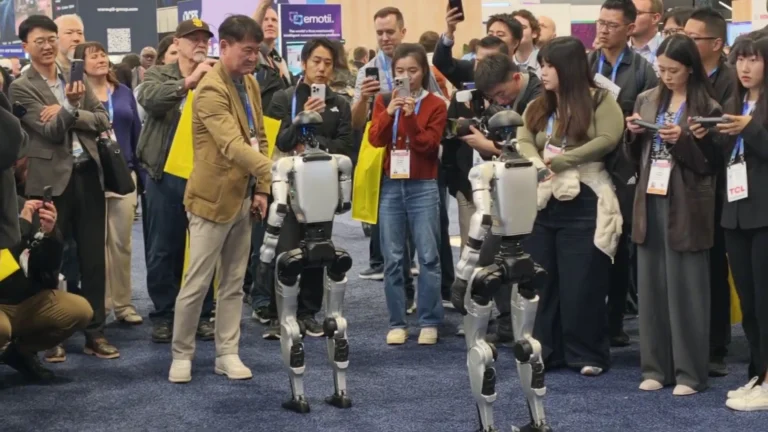
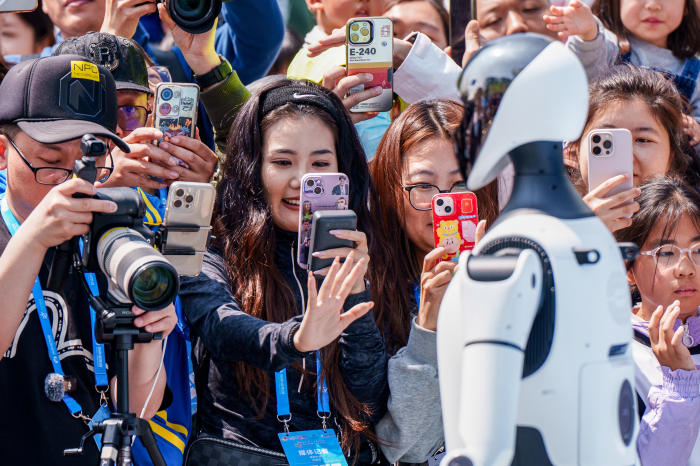
Walk past a humanoid robot in public and watch what happens to the people around it. Phones come out within five seconds. Conversations stop. People who would not pull out a phone for a celebrity sighting will record 90 seconds of footage of a robot waving at a child.
Table of Contents
This is not random. It is the predictable result of seven specific psychological levers a humanoid robot pulls all at once. Understanding them is what separates a brand activation that gets ignored from one that hits the For You page within an hour.
Pair on Stage
Image source: Alamy stock / Heinz Nixdorf MuseumsForum visitor recording Ameca
The first reason is the simplest. A humanoid robot looks like a person. Not exactly. Almost. The brain notices and cannot stop looking.
This is pareidolia operating at full force — the same instinct that lets you see a face in a power outlet or a smiley in a stack of bricks. Humans evolved to detect human shapes and faces extremely fast, because for a couple million years, that detection was a survival skill. The bipedal silhouette of a humanoid robot triggers the same circuits.
The result: even people who are tired, distracted, or hostile to technology stop and look. The brain does not know what to do with the input. It sees something that should be human, but moves like a machine. The instinctive response is to pay attention until the brain has resolved the puzzle. That attention is what your phone catches first, and what your fingers reach for second.
Reason 2: The Brain Cannot Tell What Category It Is
Most things in your environment fit a category your brain has cached — a chair, a person, a phone, a dog. The brain processes them quickly and moves on. A humanoid robot does not fit any cached category, and that mismatch holds your attention.
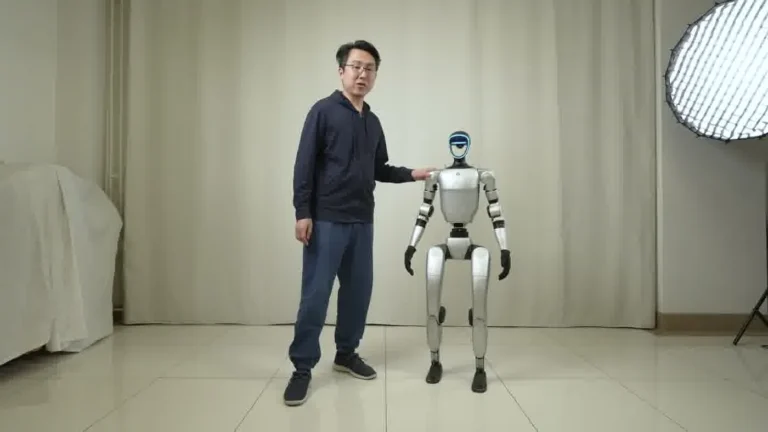
The Japanese roboticist Masahiro Mori called this the uncanny valley. A robot that is too human-like makes people uncomfortable. A robot that is clearly mechanical — like the Unitree G1 with its visible joints and servo motors — avoids the uncanny valley by being honest about what it is. You read it as a robot. You also read it as person-shaped. Both at once.
That is the cognitive double-take that produces the recorded video. Your brain wants to look longer to figure out which category it belongs to. The phone is the easiest way to keep looking after you have walked away.
Image source: WSJ / China expo humanoid robot crowd coverage
Phones are drawn to movement. The same instinct that locks your gaze on a sudden flash of motion in your peripheral vision is what tells your hand to record video.
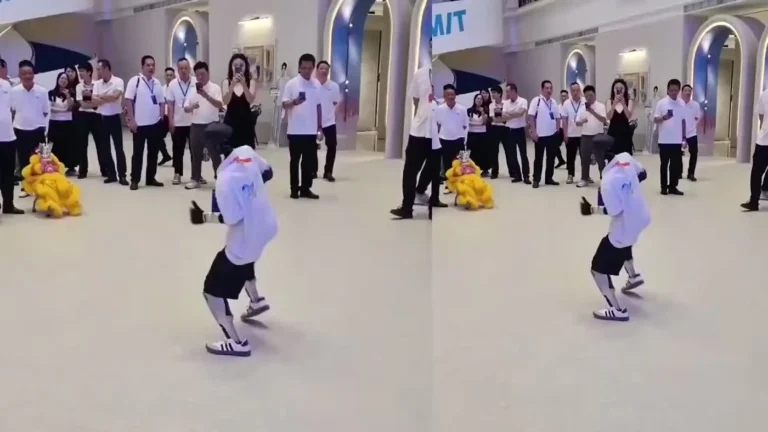
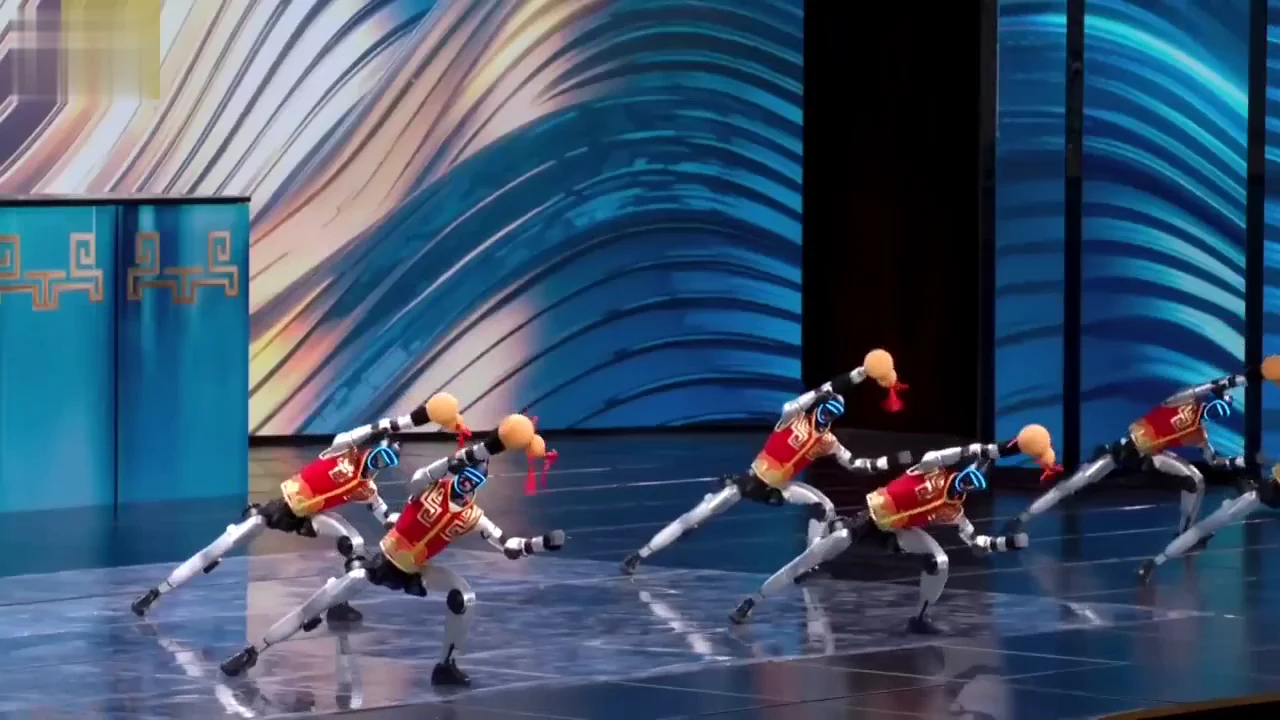
A humanoid robot is moving in a way nothing else in the room is moving. The walk is unfamiliar — close to human but not quite. The arm gestures are precise, deliberate. The head tracks toward the loudest sound. Every micro-motion is novel, and your visual system flags every one of them as worth documenting.
This is also why static humanoid demos get less engagement than ones with motion. A robot that just stands there is impressive once. A robot that turns to look at the kid who walked up to it is a clip. A robot that bows or waves or hands a flyer is a clip people share with friends. Movement is the thing the phone is looking for.
Reason 4: You Want to Be First in Your Feed
Here is the social engine. Anyone who posts a humanoid robot clip from a real-world event in 2026 gets a notable spike in engagement. Higher likes per view. Higher comments per share. Higher saves. Most users never measure this consciously, but they feel the pull.
The pull is “be the person who shows everyone the new thing first.” Status is awarded to whoever surfaces novelty within their network. A humanoid robot in public is one of the highest-status novelty items a casual social media user can capture in 2026, because relatively few people have seen one in person yet.
So the phone goes up. Not because the user thought it through, but because the social pattern has been reinforced thousands of times before. New things get attention. Posting new things gets attention back. Your feed economy rewards the post.
Image source: Independent UK / humanoid robot running and playing with kids
Once one phone goes up, the rest follow within seconds. Social proof at events is fast and visible.
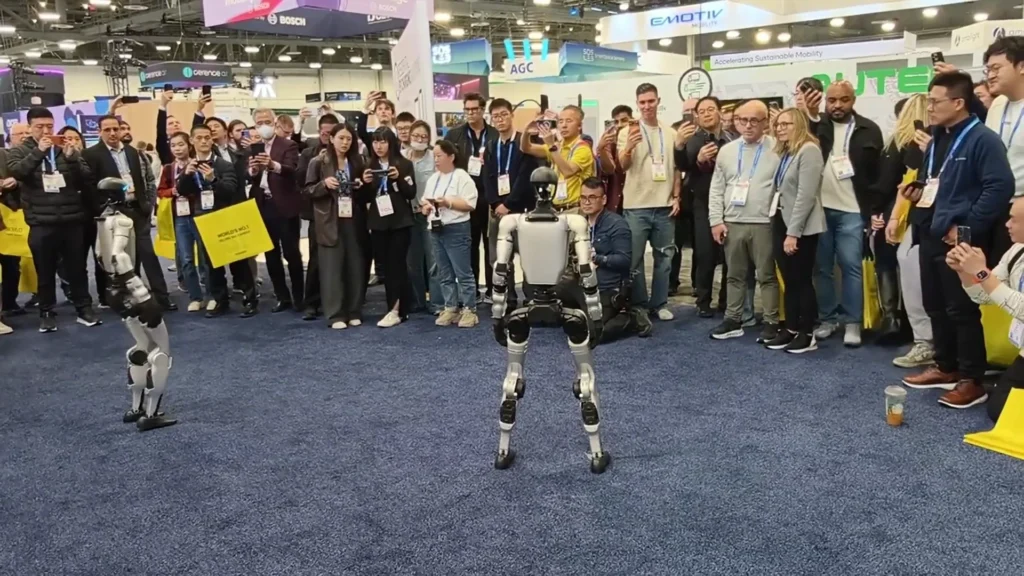
This is a real measured behavior. When one or two attendees pull out phones to record something, others nearby take it as a signal that the moment is worth capturing. The phones cascade. By 30 seconds in, every guest within 10 meters of the robot is filming or photographing.
The cascade is also what makes a humanoid activation crowd-trigger so reliably. The cascade does not work for a regular booth. People pass it without filming because nobody else is filming. The robot creates the initial trigger that breaks the silence, and then social proof handles the rest.
Reason 6: It Performs Better Than the Brand Activation Did
This one is uncomfortable to admit if you are running the activation.
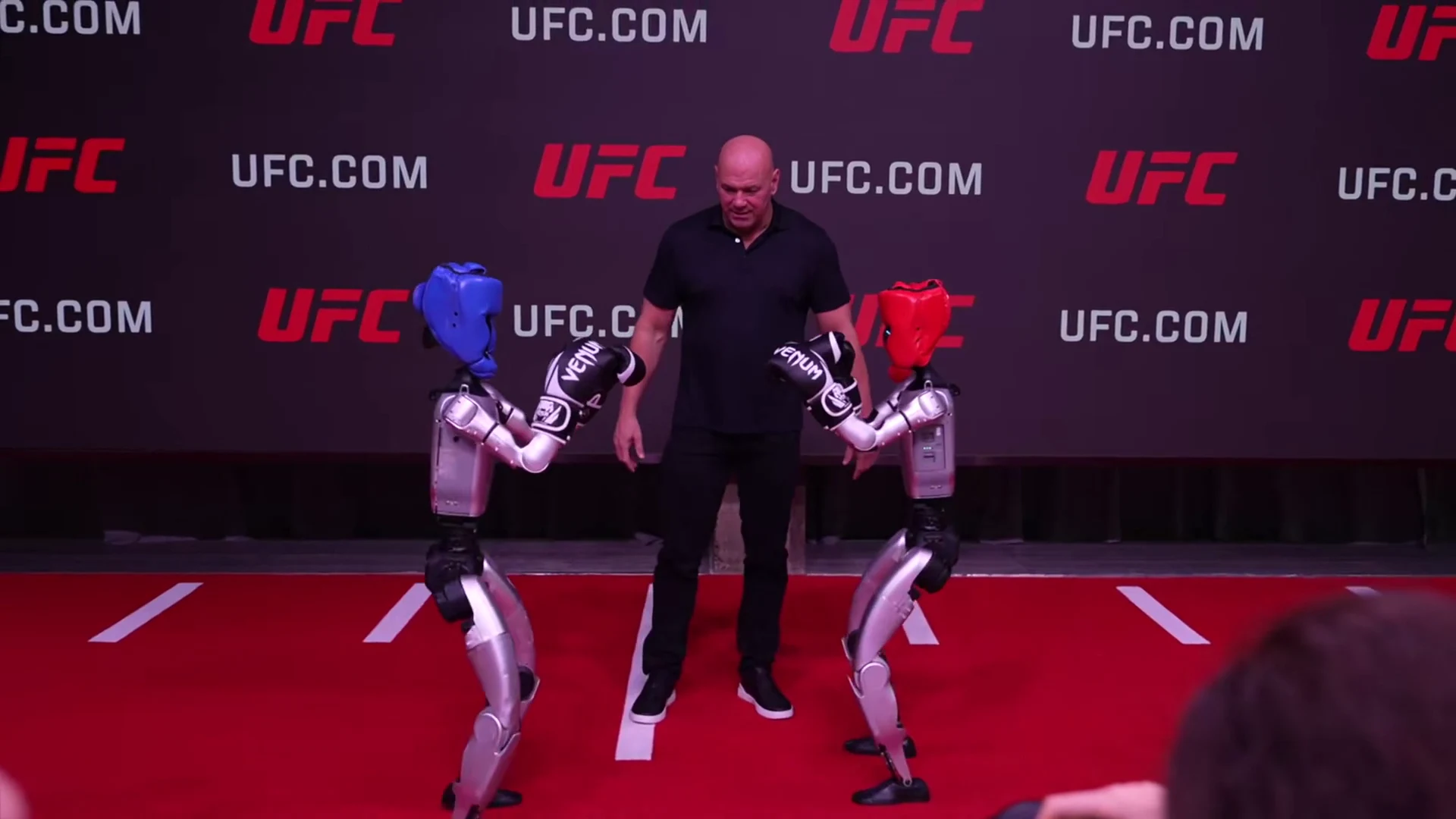
A typical trade show booth has a beautifully designed graphic, a video on a big screen, branded swag, and a smiling representative. None of those generate organic video shares. The booth is a backdrop. It is not a star.
The humanoid robot is the star. Guests film the robot, not the booth. The brand logo is in frame because the booth is in frame, but the subject of the video is the robot. This is a feature, not a bug, for the brand that booked the robot. The brand gets associated with the novelty in the viewer’s memory. The booth itself does not need to be the protagonist.
The brands that have figured this out put the humanoid front and center, design the booth around it, and let the social media organic do the heavy lifting. The brands that put the robot in a corner as a “tech demo” get less of the lift.
Image source: Fox News / XPeng Iron humanoid robot filmed by AFP media crew
Short-form video platforms reward content that holds attention through the first 3 seconds. Humanoid robots crush this metric. The unfamiliar walk, the pareidolia, the cognitive double-take — all of these compress into 3 seconds in a way few other subjects do.
The result is that humanoid clips spread faster on TikTok and Instagram Reels than almost any other event content. According to Wired reporting on humanoid robot viral patterns, a single 30-second clip from a 2025 humanoid event activation generated over 14 million views across platforms in the first 72 hours. That clip cost the brand nothing in media spend.
The platform’s algorithm treats humanoid robot footage as high-engagement-per-view content, and serves it widely. Your guests are not just sharing — the platform is amplifying. Both effects stack.
What Brands Get From This (For Free)
Putting it all together: every guest at a humanoid robot activation is doing free media work for the brand. They are filming. They are tagging. They are posting. The platform is amplifying. The friends watching are screenshotting and sharing further.
An average humanoid deployment at a 3-day trade show generates 8,000 to 30,000 short-form video views in 72 hours. The brand logo appears in roughly half. Some of those clips get featured in trade publications and amplified again. The whole loop runs without the brand spending a dollar on media beyond the rental fee for the robot itself.
According to BizBash coverage of 2026 brand activation calendars, this organic earned-media loop is the dominant reason humanoid bookings have moved from “interesting experiment” to “standard activation budget line item” in the last 18 months.
The viral mechanism is durable as long as humanoid robots remain rare in public. The window for being the brand that surfs this lift is open right now and closing slowly. The most accessible booking option in the US is the Unitree G1.
FAQ
Why do people film humanoid robots so much?
A combination of seven psychological factors: pareidolia (the brain’s instinct to fix on human-shaped figures), the uncanny valley double-take, attraction to novel motion, status seeking on social media, social-proof phone cascades, brand-activation framing, and platform-level algorithmic boost for humanoid clips. All seven stack at once.
How many social media views does a humanoid robot activation typically generate?
An average 3-day humanoid event generates 8,000 to 30,000 short-form video views in 72 hours across TikTok, Instagram, X, and LinkedIn. Top-performing single clips have generated 14 million views or more. The brand logo appears in roughly half of the clips, providing significant earned media without any incremental media spend.
Will the humanoid robot novelty effect wear off?
Yes, eventually. As humanoids become common at major events the pareidolia and novelty effects will diminish. The 2026 window is still strong because most consumers have not yet seen a humanoid in person. By 2028 or 2029 the effect will likely fade as humanoids become standard at trade shows and retail venues.
What is the uncanny valley and how does it relate to humanoid robots?
The uncanny valley is the discomfort people feel when a robot is too close to human in appearance without being fully human. The Unitree G1 and most current event humanoids avoid the uncanny valley by being honest about being mechanical — visible joints, robot heads, no synthetic skin. Engineered Arts Ameca approaches the valley intentionally because its expressive face is the product.
Does a humanoid robot generate more social media engagement than other event activations?
Significantly more. Per dollar of activation spend, humanoid deployments generate 5x to 20x the organic social media impressions of traditional booth elements like swag, signage, or photo backdrops. The cost-per-impression on humanoid rentals is sub-pennies for most brand activations.
What kind of humanoid robot footage performs best on social media?
Movement plus interaction. A robot walking calmly across a floor, a robot waving at a child, a robot bowing or posing for a photo. Static demos perform worse than dynamic ones. Routines that include human reaction shots in the same frame outperform pure robot footage. Plan event setups so guest reactions are visible alongside the robot.
The Bottom Line
People film humanoid robots because seven psychological levers fire at once — pareidolia, novelty, motion attraction, status seeking, social proof, framing, and platform amplification. The brand that books the robot rides all seven for the price of a multi-day rental.
If you want your next event to surf this lift, see availability on our humanoid robot rental page.