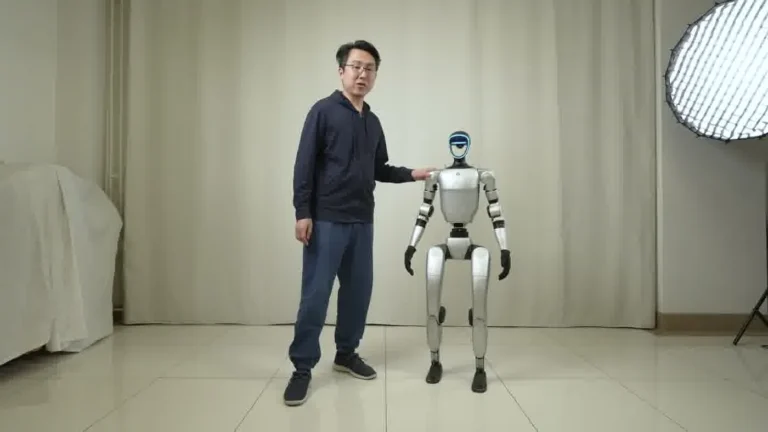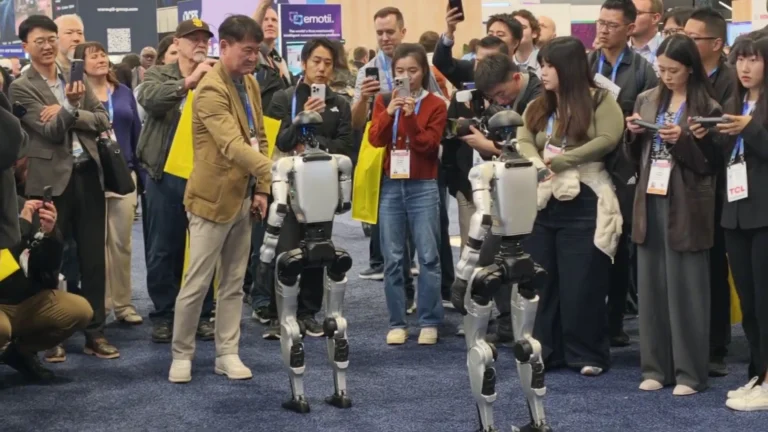
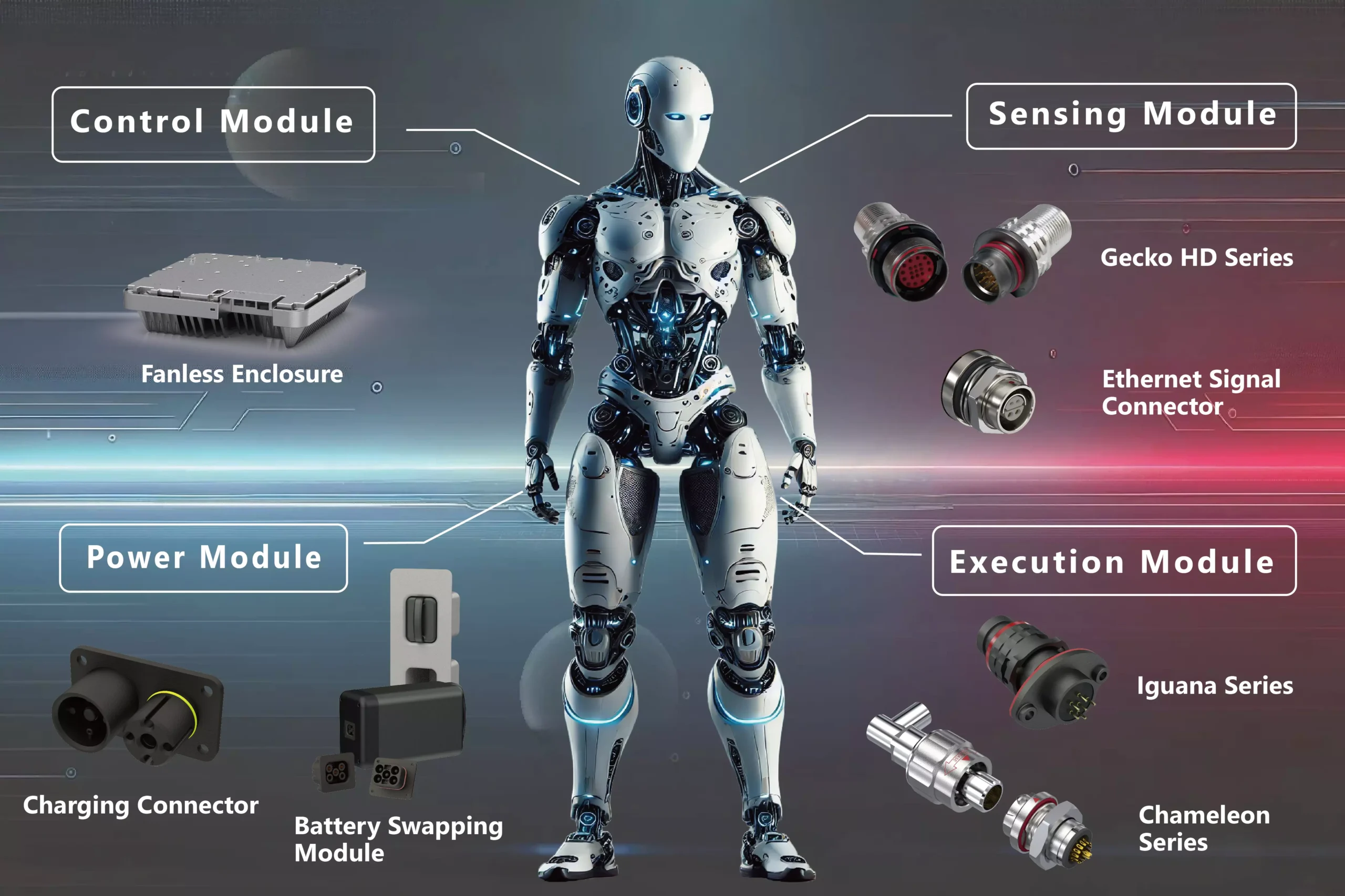
Crack open a 2026 humanoid robot and you do not see one machine. You see seven. Each one would be impressive on its own. The only reason a humanoid is impressive is that all seven happen to fit inside the same body and cooperate well enough to walk across a room.
Table of Contents
Here is the honest tour. What is actually inside a Unitree G1, a Tesla Optimus, an Atlas. What each component does. Why some of them cost as much as the rest of the robot combined. And why the missing piece is rarely hardware — it is the software gluing all seven together.
G1 Cooking Demo
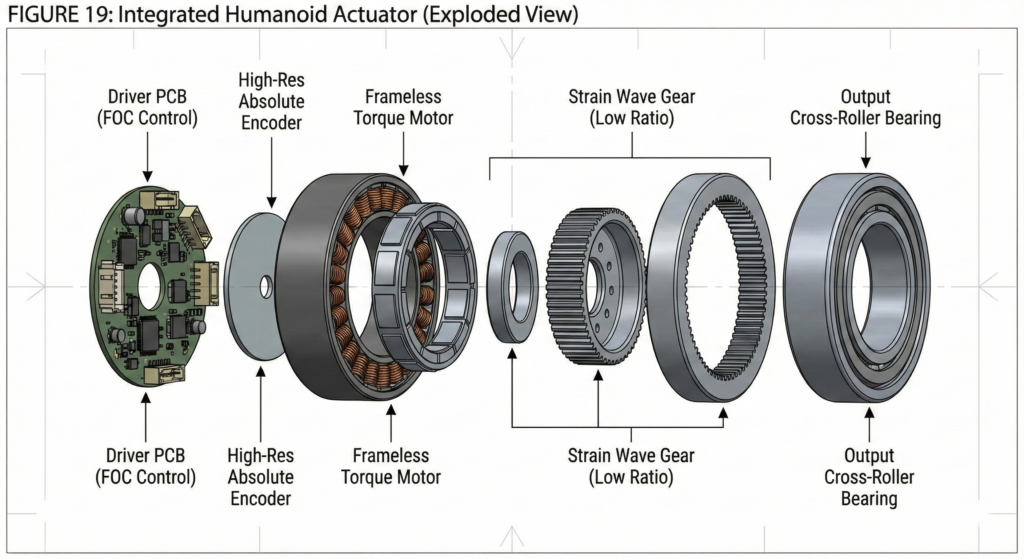
Image source: Firgelli / humanoid robot integrated actuator exploded view
An actuator is the part that moves a joint. The Unitree G1 has 41 of them. Tesla Optimus has more. Atlas has more still. They are the muscles, except they are precision electromechanical devices that cost roughly $200 to $1,500 each at scale.
An actuator inside a humanoid hip is doing several things at once. It is generating torque on demand. It is reporting back the angle the joint is at. It is reporting the strain it is under. It is responding to commands at high frequency — often 1,000 updates per second. Without that responsiveness, balance is impossible.
The reason humanoids became affordable around 2024 is that compact integrated actuators got cheap. Companies like Unitree, AgiBot, and others began building their own actuators or sourcing from a tier of Chinese suppliers, dropping per-unit costs by 5x to 10x compared to 2018 levels. The actuator price drop is the single biggest reason a $63,900 humanoid exists in 2026 instead of a $500,000 one.
Component 2: The Sensors (The Eyes, Ears, and Inner Ear)
A humanoid sees, hears, and feels through a sensor stack that looks like the inside of a smartphone fused with the cockpit of an airplane.
The Unitree G1 ships with a 3D LiDAR sensor in the head, a depth camera, an RGB camera, an inertial measurement unit (IMU), microphones, and force sensors in the limbs. Atlas adds stereo cameras for depth perception. Optimus uses Tesla’s vision-only approach — no LiDAR, all camera plus neural network inference.
The IMU is the most underrated sensor. It is a chip about the size of a fingernail that measures rotation and acceleration in three axes, hundreds of times per second. Without it, the robot has no idea which way it is tilting and falls within a step. With it, the robot stays upright across uneven floors and recovers from being bumped. The IMU did not exist as a cheap commodity component until smartphones drove the price down. Modern robotics is benefiting from the smartphone supply chain even when it does not look like it.
Image source: Sierra Circuits / humanoid robotics PCB component placement
The brain is on board. There is no cloud connection that the robot relies on for moment-to-moment operation. If the robot lost wifi mid-routine, it would keep walking, keep gesturing, and keep responding. Most operators run it that way at events — locally, with the connection only for telemetry.
The Unitree G1 ships with an NVIDIA Jetson Orin module that handles 16 trillion operations per second of edge AI. That is roughly 100x the inference power of a 2020 humanoid platform of similar size. Tesla Optimus uses a custom Tesla-designed chip. Figure 02 ships with NVIDIA hardware similar to the G1.
What this compute is doing in real time: running balance control, processing camera feeds for navigation, parsing audio for speech recognition, running pre-loaded behaviors, and handling teleoperation commands when an operator is driving. According to IEEE Spectrum coverage of edge AI in humanoid robotics, the Jetson Orin generation made on-device humanoid AI economically viable for the first time.
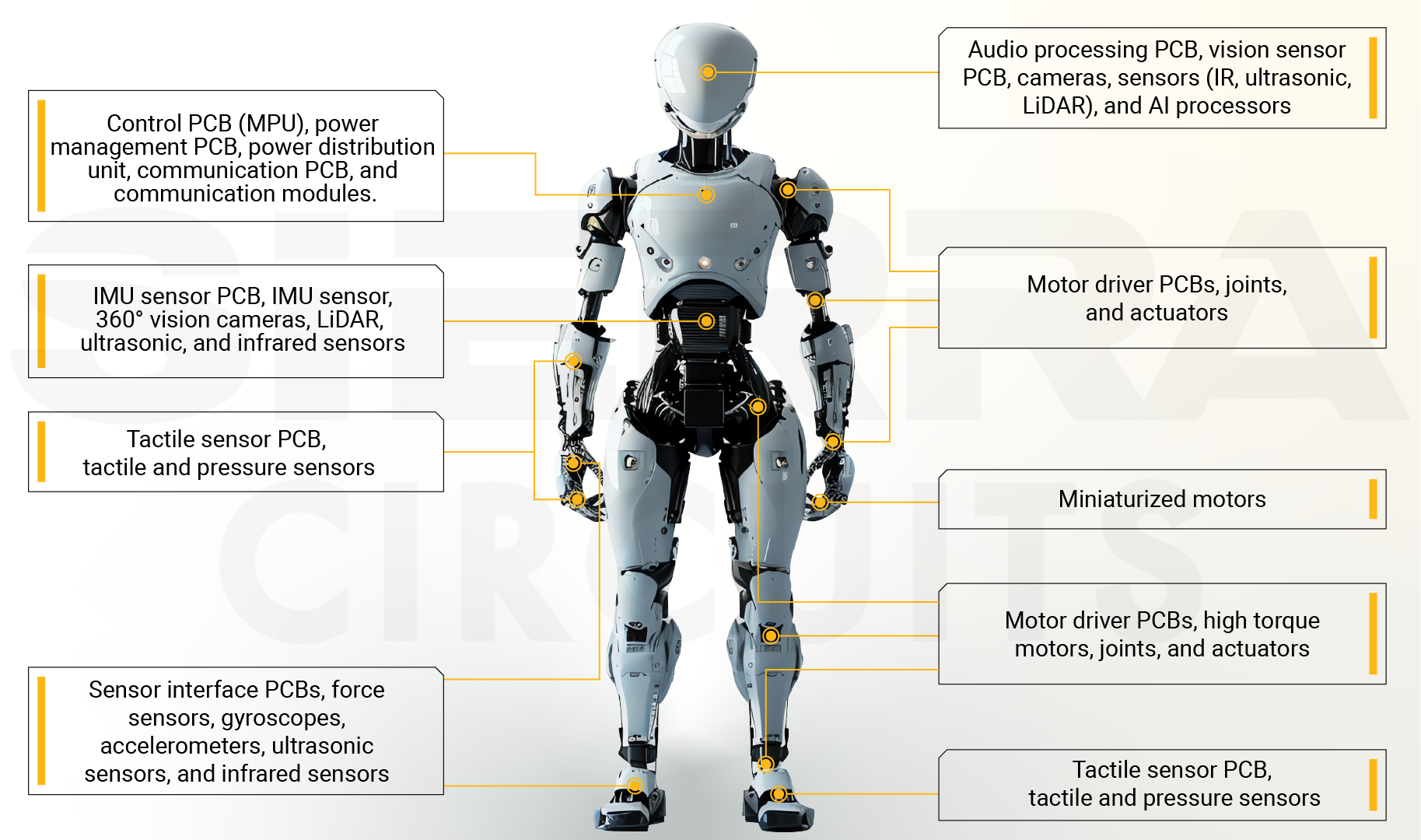
Image source: OzRobotics / humanoid robot five-finger hand joint detail
Hands are the part most consumers do not think about. Roboticists know they are the hardest part.
The Unitree G1 ships with five-finger dexterous hands made by BrainCo. Each finger has its own actuator. Each finger reports its own position and force. The whole hand has 12 to 25 degrees of freedom depending on configuration — compared to your hand, which has roughly 27.
The cost of a high-quality humanoid hand alone is $5,000 to $15,000 per unit. That is per hand, not per pair. If you ever wonder why some humanoid manufacturers ship their robot with simpler grippers (claws or two-finger pinchers) instead of full dexterous hands, the answer is bill of materials. Dexterous hands roughly double the per-unit cost of the robot.
What dexterous hands let you do at events: hand objects to guests gracefully, hold microphones, perform complex gestures, do high-fives. What they still cannot do reliably: tie a shoe, button a shirt, type. The hardware is ahead of the software. That gap will close. It has not yet.

Component 5: The Battery and Power System
The Unitree G1 runs on a lithium-ion battery pack rated for roughly 2 hours of active operation. Atlas is similar. Optimus is roughly 90 minutes. None of these last all day.
Battery technology is the single biggest constraint on humanoid runtime in 2026. The motors are efficient. The compute is power-hungry. The locomotion subsystem alone draws 200 to 400 watts during active walking. Add the compute, the sensors, the displays, and the radios, and you are above 600 watts continuous. Two hours from a battery that fits in a torso is not bad — it is the limit of current chemistry at this size.
Hot-swappable batteries are how event teams handle this. Most modern humanoids let an operator swap a battery in 60 seconds. Two batteries plus a charging station give you continuous deployment. The battery is the constraint, not the runtime.
Component 6: The Software Stack
Open up a humanoid and you see the hardware. The software is what you cannot see, and it is where most of the value lives.
The stack inside a 2026 humanoid runs at three levels. At the bottom: real-time motor control. Microsecond response times for joint torque. Without this, balance is impossible. In the middle: motion planning and behavior libraries. The pre-programmed routines, the safety overrides, the gesture catalogs. At the top: the AI layer — speech recognition, computer vision, language models, behavior trees that compose actions in response to context.
Each level is its own engineering specialty. Each level has bugs the manufacturer fixes through firmware updates. The Unitree G1 ships with a stack that has been refined over multiple model generations. Newer entrants like Figure AI and 1X are racing to catch up at the top of the stack while leaning on more mature low-level controllers borrowed from existing codebases.
This is also why the same hardware can produce wildly different demos depending on the team running it. The robot is the platform. The software is the show.
Image source: Nextronics Engineering / humanoid robot evolution structure breakdown
The frame is the skeleton. The skin is the cosmetic shell that hides the wires.
Modern humanoid frames are aluminum or carbon fiber composites, milled to tight tolerances. Boston Dynamics Atlas is famously precision-machined. The Unitree G1 uses a more cost-optimized aluminum frame. Both work. The trade-off is mass: lighter frames mean better battery efficiency and easier balance, but lower payload capacity and higher manufacturing cost.
The skin is more than cosmetic. It hides the wiring, protects the actuators from dust and impact, and gives the robot a consistent look on camera. The Engineered Arts Ameca uses synthetic skin to enable expressive faces. The Unitree G1 uses simple plastic shells. The 1X Neo uses a soft fabric exterior intended to make the robot less intimidating in homes.
None of this is glamorous engineering. All of it matters when the robot is in front of guests for 8 hours straight.
Why Each Component Matters at an Event
Now zoom out. At a brand activation, all seven components are working together every second the robot is in front of guests.
The actuators handle the walk. The sensors handle navigation around guests. The compute is running the balance loop and the gesture library at the same time. The hands are picking up flyers and handing them out. The battery is being monitored for swap timing. The software stack is running the scripted routine and listening for the operator’s tablet commands. The frame is taking the small bumps and shoulder-checks that come with crowded venues.
If any one of those seven fails for ten seconds, the demonstration fails. That is what makes humanoid robotics hard, and what makes a successful event humanoid impressive. According to The Robot Report coverage of humanoid commercial deployments, the gap between consumer-grade and event-grade humanoids is largely a function of how reliably the seven components stay synchronized under stress.
The Unitree G1 you can rent through ZMProbots is event-grade. That is why it shows up on time and walks through 8 hours without drama.
FAQ
What are the main parts of a humanoid robot?
Seven main components: actuators (the joints), sensors (cameras, LiDAR, IMU, microphones), onboard compute (the AI brain), hands (the manipulators), battery and power system, software stack, and frame plus skin. Each component is engineered separately and integrated through firmware.
What is an actuator in a humanoid robot?
An actuator is the part that moves a joint. The Unitree G1 has 41 actuators. Each one generates torque on command, reports its position, reports its strain, and responds to control signals at high frequency — often 1,000 updates per second. Modern integrated actuators became affordable around 2024, which is the main reason 2026 humanoids cost a fraction of the 2018 generation.
How much compute power do humanoid robots have on board?
The Unitree G1 runs an NVIDIA Jetson Orin module rated at 16 trillion AI operations per second. Tesla Optimus uses Tesla’s custom chip with similar inference capability. Figure 02 uses NVIDIA hardware comparable to the G1. The compute runs balance control, vision processing, audio recognition, and behavior libraries simultaneously.
How do humanoid robot hands work?
Five-finger dexterous hands like the BrainCo hands on the Unitree G1 have an actuator in each finger and 12 to 25 degrees of freedom. Each finger reports its own position and grip force. The hand can grip microphones, hand props, perform high-fives, and do most gross manipulation. Fine manipulation like buttoning a shirt is still beyond reliable performance.
What sensors does a humanoid robot use?
Typically a 3D LiDAR or stereo cameras for depth perception, an inertial measurement unit (IMU) for tilt and acceleration sensing, RGB cameras for vision, microphones for audio, and force sensors in the limbs. The IMU is the unsung hero — without it the robot cannot stay upright. The smartphone supply chain has driven IMU costs down to single-digit dollars per unit.
How long can a humanoid robot run on battery?
Roughly 90 minutes to 2 hours of active operation per charge for current generation humanoids including the Unitree G1, Atlas, and Optimus. Hot-swappable batteries enable continuous deployment at events. Battery is the single biggest constraint on humanoid runtime in 2026, and is unlikely to change dramatically until cell chemistry advances.
The Bottom Line
A humanoid robot is seven engineered components synchronized by software that took 30 years to figure out. Actuators, sensors, compute, hands, battery, software, and frame — all working together to produce a robot that walks across your trade show floor without falling.
Curious to see one in person? See availability on our humanoid robot rental page.